

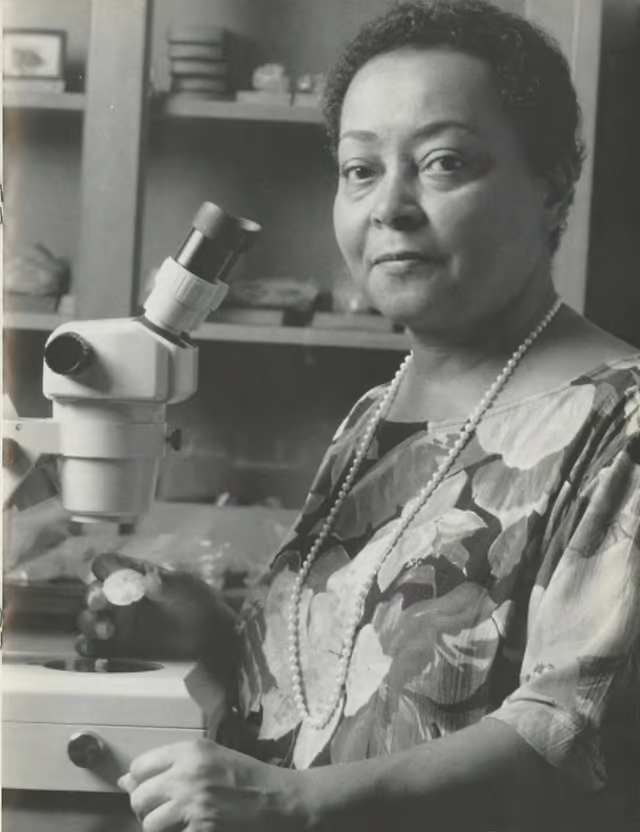
From a young age Dr. Owens had a deep love of the oceans. Her parents would take her and her two sisters fishing on the weekends and both encouraged their daughters to pursue higher education. Reading about both Jacques Cousteau and Eugenie Clark (the Shark Lady) added fuel to her dream of becoming a Marine Biologist and kept her going when the road got complicated. She attended the historically Black school Fisk University even though they did not have a Marine Biology program. Being Black and female in the 1950s meant taking more acceptable courses of study.
With a voracious appetite for knowledge, Dr. Owen’s first degrees were in Fine Arts, Math, Psychology and Guidance Counseling. After a successful care as a teacher at both the University of Michigan’s Children’s Psychiatric Hospital and Howard University, and creating a program to teach English to disadvantaged Children which would influence the US’s Upward Bound program, Dr. Owens started over again, going back to school in 1970, at the age of 37. She studied geology and zoology at George Washington University, receiving a Bachelor of Science in 1973 and a Masters of Science in 1976 and in 1984 earned her PhD, in Geology. While working on her degrees she worked at the Smithsonian Institution’s National Museum of Natural History cataloging specimens in the paleontology department’s collection.
Having been born with sickle cell anemia traits, which limited the amount of oxygen in her blood cells, Dr. Owen’s was unable to dive to research and collect samples herself. This could have limited her ability to study and work in her field but her connection to the Smithsonian allowed her to work on an existing collection of button corals, the eventual subject of her doctoral dissertation. Through her meticulous work Dr. Owens described and catalogued each button coral in the collection. She made several lasting contributions to her field: She discovered a new genus of button coral called Rhombopsammia, three new species, once of which she named after her husband Frank, and her hypothesis that deep water coral were more mobile than shallow water coral due to the availability of calcium carbonate during the Cretaceous period.
“It’s important because of its contributions to our understanding of the life of the sea and some of the ways in which ecology and evolution interact. Also, it is important to others working with deep-water organisms because of some of the relationships I think I indicated—if not proved—between water depth and availability of calcium carbonate that influenced the physical evolution of some organisms.”
– Joan Murrell Owens, 1996.
Links: