

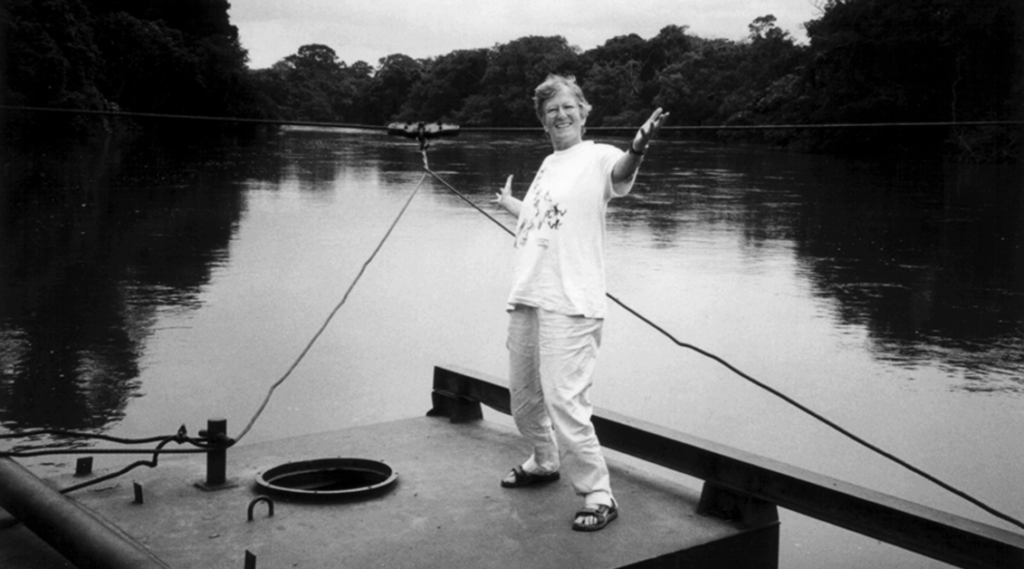
ID: Black and white photo of a smiling, middle aged, white woman with short hair, her arms out stretched. She’s wearing an over-sized white t-shirt, khaki pants and dark sandals. She stands on a flat surface (possibly a barge) on a smooth water way, surrounded by trees
Katy Payne does not have a doctorate or much in the way of papers with her name on them but her curiosity and early love of music lead to monumental breakthroughs in our understand of whale song and elephant communication.
Born in in Ithaca, NY in 1937 Payne studied biology and music at Cornell University, where her father was a professor. In 1966 she and her then husband, Dr. Roger Payne, began studying recordings US Navy Engineer Frank Watlington had captured of ‘odd sounds’ in the ocean. Payne’s ear for music gave her a unique perspective on the sounds which eventually led to the understanding that Humpback whale songs contained not random sounds but musical phrases and distinct, repeated patterns. She and her fellow researchers developed a system of photographing the tail flukes of each whale they they saw – a pattern which, in Humpbacks, is as distinct as a fingerprint and can be used to ID individual whales. With that identification mark, they started a catalogue of Humpback whales with a technique still used today. Over time they were able to connect recordings of specific individuals with the IDs of the whales singing, allowing them to build an understanding of who, what, and when they sing. (HappyWhale.com where I submit my whale photos, uses this process.)
Decades later, life brought Payne back to land and to a zoo in Portland where she ended up listening to a group of elephants. The elephants were clearly communicating, somehow, but the humans couldn’t hear anything. After hours of listening while the elephants moved around the large yard, Payne noticed shifts of air pressure as the elephants passed by. Payne’s musical background again offered a clue. The air shifts were sounds the humans could feel, like a deep bass note Payne remembered from singing in a choir, but too deep for them to hear. Using recordings and tech to modify the sounds, the team determined that elephants speak on an infrasonic level.
In 1999 she founded Cornell‘s Elephant Listening Project. The organization focuses on forest elephants, and has built the world’s largest archive of sounds from Central Africa. She also published “Silent Thunder, In the Presence of Elephants” which is part memoir and part observer’s notes about her early experiences with elephants. In 2002 Cornell Lab of Ornithology announced the Katharine B. Payne Fellowship Program in Conservation Bioacoustics. The Fellowship does not require applicants to have an advanced degree.
Note: Silent Thunder is only available in print but the Internet Archive has a scanned version available for reading. Book Scanned/e-view (requires a free membership)
Additional Links:
On Being with Krista Tippett, Katy Payne episode: In the Presence of Elephants and Whales
NPR: It Took A Musician’s Ear To Decode The Complex Song In Whale Calls